Replacing Real API Calls With Horizontally Scalable Simulator Fleets to Unblock Eval Throughput
Isolated, stateful simulators remove the API throttle that caps agent eval scale.
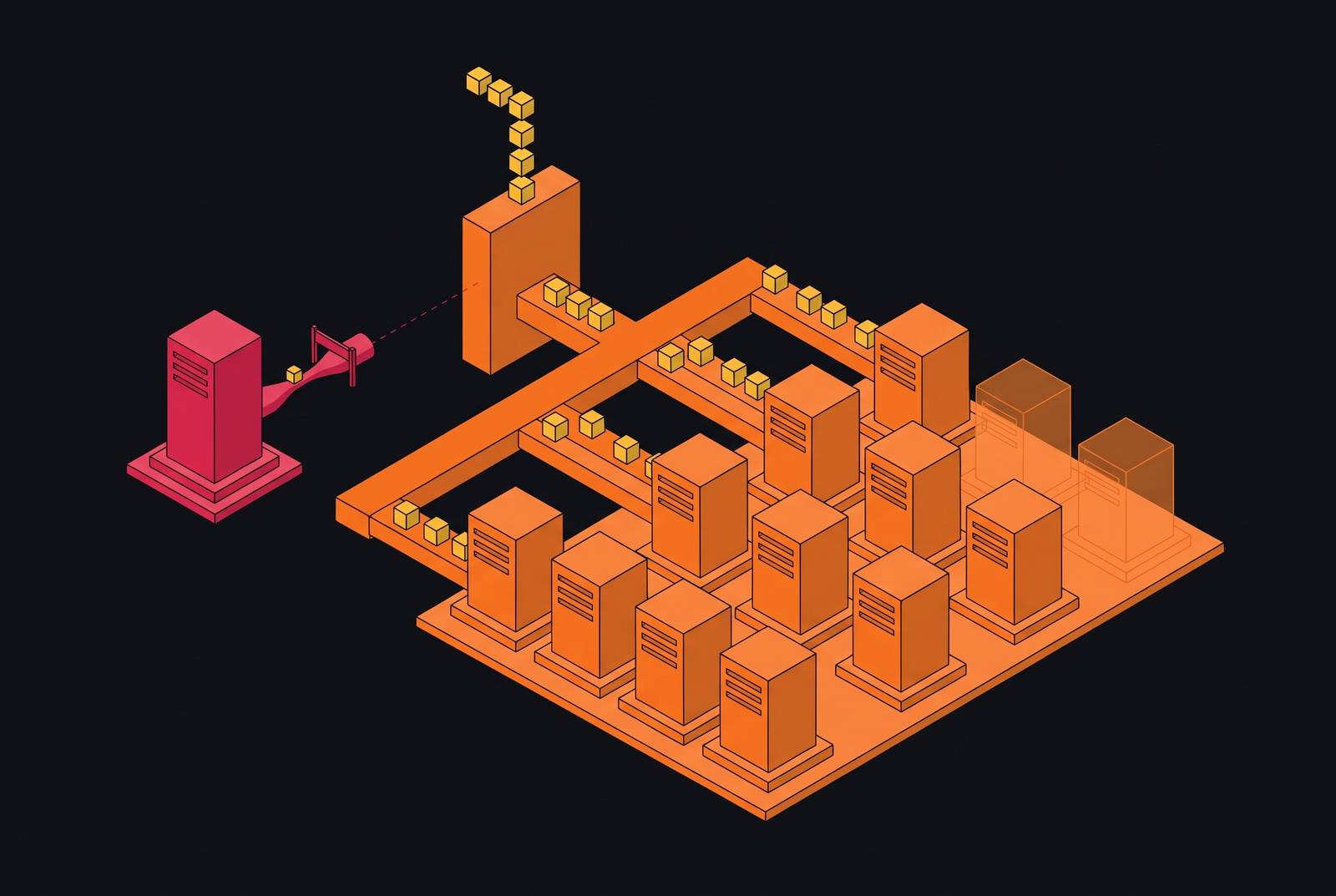
To use an API for agent evals at scale, replace live calls with a horizontally scalable fleet of stateful simulators, one isolated instance per eval worker. This removes the shared API throttle and keeps the resource lifecycles that multi-turn agents must work through. The design works only if each instance keeps its own state, is checked continuously against the live API, and can reproduce failure scenarios.
Why eval throughput hits a wall before compute runs out
The Holistic Agent Leaderboard (HAL) accounted for thousands of agent rollouts across nine models and nine benchmarks, making evaluation cost a first-order engineering concern. Exgentic found a very large cost spread across agent configurations on identical tasks, isolating scaffold choice as a major cost driver. Model price alone does not explain the bill. The way an agent runs determines how many steps and external calls an evaluation consumes.
A statistically credible HAL-style evaluation uses k=8 reruns per cell, so a manageable individual rollout can become expensive across a full evaluation matrix. When those rollouts depend on live, rate-limited, money-wired APIs, available compute is not the only constraint. Each new worker still adds to the same external billing counter and uses the same shared throttle. Spare compute cannot remove either dependency.
Why a shared rate limit cannot be scaled around with more workers
Most live API providers enforce rate limits at the account or key level. Ten parallel eval workers thus have to share the same allowance. Adding workers increases contention while the provider’s permitted throughput remains unchanged. Per-call billing remains unchanged as well, so greater concurrency can compress spending into less wall-clock time without reducing the cost of a rollout.
The constraint sits in the dependency topology. Multiple workers call the same external service, and the eval harness has no control over its limits. Moving those calls to a sandbox does not solve the problem if that sandbox still imposes a shared throttle. The workload remains dependent on a resource that cannot be replicated with each worker. Removing that constraint requires changing where tool calls go.
What a simulator fleet is and how it dissolves the shared-throttle problem
A simulator fleet replaces the shared external endpoint with isolated instances hosted locally, one for each eval worker. The worker calls its simulator through localhost. Those calls use none of the provider’s rate allowance or its per-call billing budget. Each worker has its own independent execution environment. The harness can start instances on demand, reset them between rollouts, and tear them down without external side effects.
Containerization makes this topology practical across compute environments. The SUNRISE paper describes a stable EvalAPI accessing one or multiple compute back-ends, ranging from local Docker to HPC centers. For an API simulator fleet, the equivalent boundary lets the harness manage containers while the agent continues to make API calls. The endpoint changes, but the evaluation still exercises tool use.
The sim-eval-scale framework separates GPU count, simulator process count, and vectorized environments per process. Each world becomes an independently schedulable unit. API simulation can use the same separation, with one setting for worker count and another for hardware allocation. Throughput then depends on how many independent environments the available compute can support. That architectural gain, however, says nothing yet about whether an individual simulator represents the API correctly.
Why stateless mocks fail as the simulator fleet building block
Consider an agent that creates an order, polls its status, and tries to cancel it after completion, receiving a 409. The correct responses depend on earlier actions and the order’s current state. A mock that returns the same status fixture either ends polling at once or leaves the agent polling forever. It cannot reproduce the conflict as a consequence of the order’s lifecycle.
Static mocks return one response per endpoint, while conditional mocks change their responses based on the request and cover many error paths without persistence. Stateful simulators keep data between requests, so what an agent creates can later be read, listed, and deleted. Multi-turn rollouts require that continuity to produce coherent trajectories. Otherwise, a score can reward behavior that would fail against the actual service.
Recorded cassettes impose a related but different restriction. They replay a fixed sequence rather than maintaining a world that responds to the agent’s choices. If the agent takes a different tool-call path, the recorded responses may no longer correspond to its actions. Replay can test a particular trajectory, but not open-ended navigation of a resource environment. Replicating that mismatch across a fleet produces more results without making them more trustworthy.
What shared state across simulator instances does to horizontal scaling, and how to avoid it
State must persist within a rollout and remain isolated between rollouts. If workers share a simulator or an unisolated backing database, a record created by one worker can appear in another worker’s list response. The second trajectory then depends on concurrent activity outside its scenario. Evaluation runs stop being independent and reproducible. A shared session store also adds coordination to the very path the fleet was meant to separate.
Routing sessions consistently can preserve access to the right state, but it does not itself provide independent, on-demand worlds. With sticky routing, each worker is limited by how much its assigned instance can handle, while an external state store adds another shared dependency. Neither approach is necessary for isolated eval rollouts. Each worker can instead own a simulator with its own in-process state and no external coordination. Statefulness and horizontal scaling are compatible because the state boundary matches the worker boundary.
The sim-eval-scale topology expresses the same isolation principle through processes_per_gpu=N and envs_per_process=1, yielding N independent worlds per GPU. API simulators apply the pattern as one container, one state store, and one worker. Containers can start in seconds with ephemeral state and be destroyed after the rollout. Their lifecycle becomes the session lifecycle. There is no cross-worker state to reconcile when an instance ends.
Fidelity drift: why a simulator fleet degrades silently if it isn't continuously verified
The Kalshi Python SDK’s scheduled Spec Drift Detection runs found that its contract suite no longer matched upstream OpenAPI/AsyncAPI on October 14, October 17, October 22, and October 29, 2026. That roughly weekly cadence makes drift an operational concern. A simulator can keep working by its own rules even as it falls behind the service it models. Its fleet may continue passing evaluations because nothing inside those environments exposes the changed upstream contract.
Verification methods detect different kinds of divergence. Spec-to-spec diffing compares document versions, which requires specifications to exist and describe the API accurately. Spec-to-reality monitoring checks live responses against the specification, while reality-to-reality monitoring checks live requests against a learned baseline and does not need a spec. Probe-based simulator verification makes real calls and checks how the responses compare with what the simulator does. It can expose divergence even before the documentation changes.
Continuous verification is therefore part of the architecture. Handwritten fixtures inherit their author’s understanding, and spec-derived mocks inherit the document’s accuracy. Neither automatically reveals when its assumptions become stale. Re-probing supplies an observable signal through probe coverage and pass rate, with a declining pass rate warning that fidelity has changed. A published probe count and nightly verification schedule give teams an audit trail.
Fault injection as a first-class capability in a simulator fleet
Control over the environment enables more than replacing successful live calls. It also makes failures reproducible across parallel rollouts. An eval harness cannot instruct Stripe’s production API to return a 503 on the seventh call, and incidental sandbox errors do not provide a parameterized test. A simulator can make the failure part of the scenario.
Within the fleet, one instance can return a 429 after N calls, another can inject latency on selected endpoints, and another can return a 503 mid-task. Each worker runs on its own under the conditions set for it. This supports a parallel matrix of failure scenarios without mixing their state or results. A retry loop following a mid-task failure becomes behavior the evaluation can exercise before production. Functional success alone does not establish that resilience.
The same isolation boundary also makes these scenarios suitable for CI/CD. Fault configurations can be test fixtures running in the same pipeline as clean-environment evaluations. Resilience testing becomes a routine checkpoint rather than a separate exercise dependent on external service behavior. This is an additional benefit of the fleet topology. It gives teams control that a live API cannot offer on demand, while fidelity verification still has to check that the behavior matches the real service.
Which specific APIs have verified simulators ready to fleet today
Emulate offers stateful, production-fidelity local replacements for Stripe, GitHub, Google, AWS, and several more services. Its documented workflow supports importing replacements into Vitest or Jest, starting them per-suite, and resetting them between tests. Those lifecycle controls fit isolated evaluation environments.
Support for a named API does not establish how much of its behavior has been probed or how recently those probes passed. The product claims described here do not establish a published fidelity score, probe count, or verification cadence. Calling these replacements continuously probe-verified would therefore go beyond that evidence.
Kalshi describes demo.kalshi.co in its docs as a demo environment with mock funds and separate credentials for each account. That provides a place to explore API behavior without using real funds, but the documentation does not establish per-worker instantiation or reset controls. It is not evidence of a locally replicable fleet. Where a suitable simulator is unavailable, static mocks and live sandboxes retain their respective limits on trajectory realism and independently scalable execution.
How can you use an API for agent evals in practice?
The implementation pattern follows directly from the constraints established earlier. To put it into practice, provision one simulator container per eval worker at job start through Docker or a container orchestrator. Give each instance a local port and realistic scenario data, with state owned entirely by that worker’s rollout. Point the agent’s API calls at that local endpoint. No shared simulator state or live API dependency belongs in this execution path.
During execution, creates, reads, updates, and deletes must operate on the same in-process world so that the trajectory remains coherent and scorable. Designated workers receive configured faults, including latency injection, a 429 on call N, or a 503 on a selected endpoint. Clean and fault-injected workers run in the same parallel fleet. The pipeline can produce functional and resilience scores together. Between rollouts, reset the instance or destroy it so that the next scenario starts from known-clean state.
When the job ends, tear down the containers that are left. This leaves no shared service state to clean up and keeps workers from depending on the order in which tests run. In CI/CD, a merge-level job can provision the fleet, execute the eval matrix, score trajectories, and complete teardown without live API credentials. The quality gate becomes the eval score, while continuous probe verification remains responsible for simulator fidelity. These are distinct obligations, and neither substitutes for the other.
For capacity planning, keep process count, environments per process, and GPU allocation separate, following the topology distinction in sim-eval-scale. The useful unit is an independent, correctly modeled rollout environment. More local environments still require more hardware. With isolated state and verified behavior in place, however, the throughput limit is internal compute.