Seeding and Forking Simulator State Snapshots to Cover Every Stateful API Branch an Agent Might Encounter
Forked simulator snapshots let agent tests cover every order-dependent API branch.
Integration testing against stateful APIs requires a simulator that preserves mutations, canonical snapshots that encode meaningful starting states, and isolated forks for each call branch. This workflow tests order-dependent behavior without touching production or replaying the full setup sequence. Its coverage is trustworthy only when the simulator is continuously checked against the live API and each branch is tested under failures as well as normal conditions.
Why stateless mocks cannot test APIs where order of operations matters
A real API maps a request and its current state to an updated state and an output. The agent sees only the output. A stateless mock removes that dependency by returning a canned response regardless of prior mutations. History disappears from the test. Such a fixture can validate an individual response handler, but it cannot establish that a sequence of writes and reads produces the right cumulative result.
Agents make this limitation harder to contain because each tool result can change the next action. The SimSAT paper describes the resulting coverage tree, in which states branch at successive steps and static fixtures cannot fully represent the paths. Consequently, green CI can conceal a late-step orchestration bug when tests replace the LLM without exercising retry logic, state accumulation, or fallback routing. A malformed tool response can expose that gap.
What a stateful simulator actually models that a mock does not
A stateful simulator persists mutations across calls, enforces state-machine transitions, and fires webhook events when the modeled service requires them. When a record is added, it changes what a later list request returns, and when it is deleted, the result changes again. Each call inherits the preceding calls’ effects. Sandbox products must therefore be distinguished by their behavior. A server is stateless if it ignores earlier writes.
Persistent state alone, however, does not make an environment useful. An empty sandbox omits the history that makes an agent’s next decision difficult, so testing needs pre-seeded realistic data with meaningful relationships and prior mutations. Starting state is part of the test. That state must also obey the real service’s rules, which can change as the API evolves. Fidelity erodes incrementally when a simulator fails to track those changes.
Constructing canonical seed states that represent meaningful branch origins
A canonical seed is a precisely crafted snapshot that places the simulator at a known, reproducible branch origin. Its value comes from the decision it exposes. A Stripe customer with an active subscription, a failed payment, and a pending dispute presents different possibilities from a customer with no payment history. The seed must encode the records, their relationships, and the prior mutations that distinguish those situations.
Constructing a canonical seed requires identifying the prior state that makes the next agent action ambiguous or multi-pathed. A GitHub repository with an open PR, a failing CI check, and a pending review comment supplies such a point. So does a Slack channel with an unread mention and a draft reply. These states make alternative next actions plausible. DeltaBox frames the same requirement for training as starting from “the same testbed snapshot, with the same toolchain pre-loaded,” rather than capturing whatever environment happens to exist.
Replaying setup can recreate these conditions, but its cost compounds across branches and runs. The agentenv-framework issue #267 reports that deploying the environment and starting its stack from a cold image takes roughly 117 seconds per rollout. ClawsBench addresses reproducibility with five SQLite-backed services and validates fidelity using golden request-response pairs from real accounts.
When and why to fork a snapshot rather than restore from it
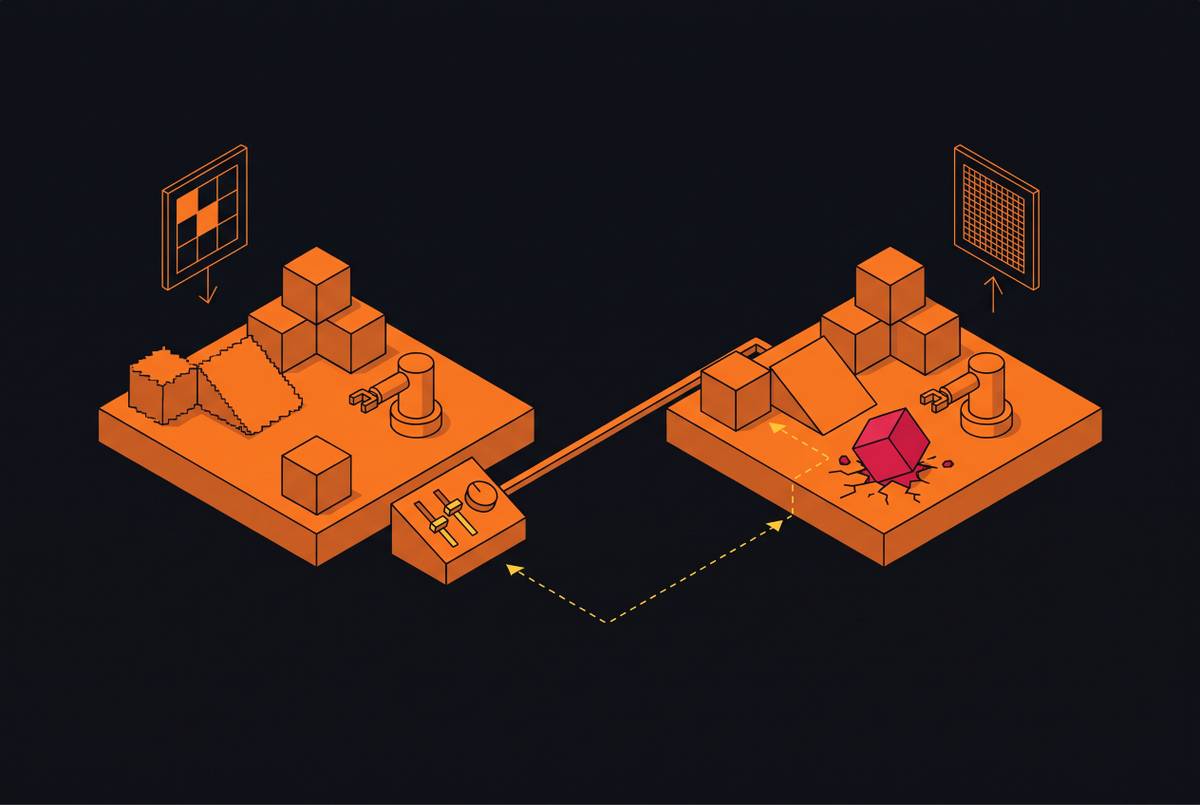
A snapshot is a frozen capture that supplies the same baseline across runs, even after its source has been deleted. A fork copies a live sandbox at a particular moment, including memory, processes, and service state, without a separate save step. The distinction determines the workflow. Prepared baselines belong in reusable snapshots, while forks suit mid-episode branching after valuable mutations and context have accumulated. Restoring a baseline and branching an ongoing rollout solve different problems.
The same issue reports snapshot saves of roughly 3.8 seconds on boxd, followed by restores that accept execution in just over two seconds. Forks can start executing sooner, but they need a live source and work only with specific backends. These figures show the trade-off, but times can differ on other systems. Database housekeeping, timers, logs, and gateway state can change a running source between copies unless it is paused. Keeping that source alive also means paying to keep it running.
For intermediate branching, that live source is precisely what the test needs. Several continuations can start where one agent reached a useful decision point by reusing its history. StateFork, from Columbia DAPLab in 2026, exposes snapshot, restore, and branch operations through a common interface across supported backends. The agent loop can stay the same when the backend changes. Morph Cloud exposes managed pause, snapshot, fork, and resume operations for parallel exploration and caching expensive setup.
How the branch matrix maps canonical seeds to the stateful scenarios agents encounter in production
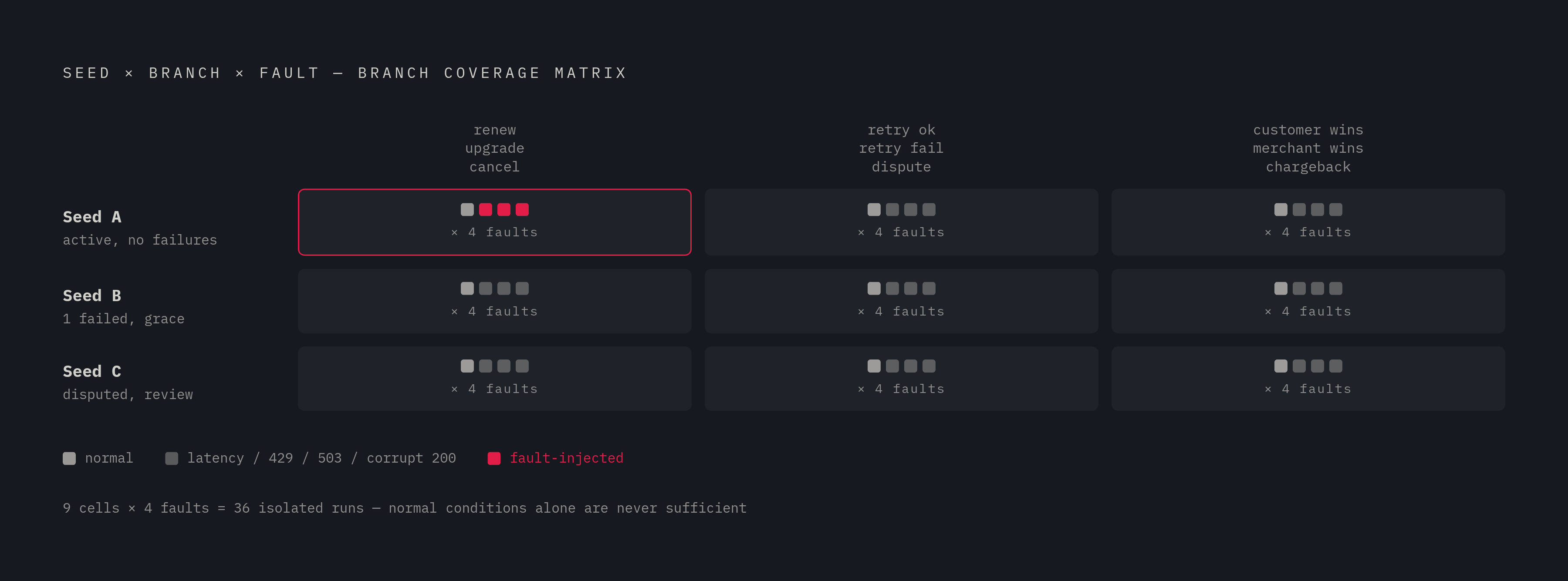
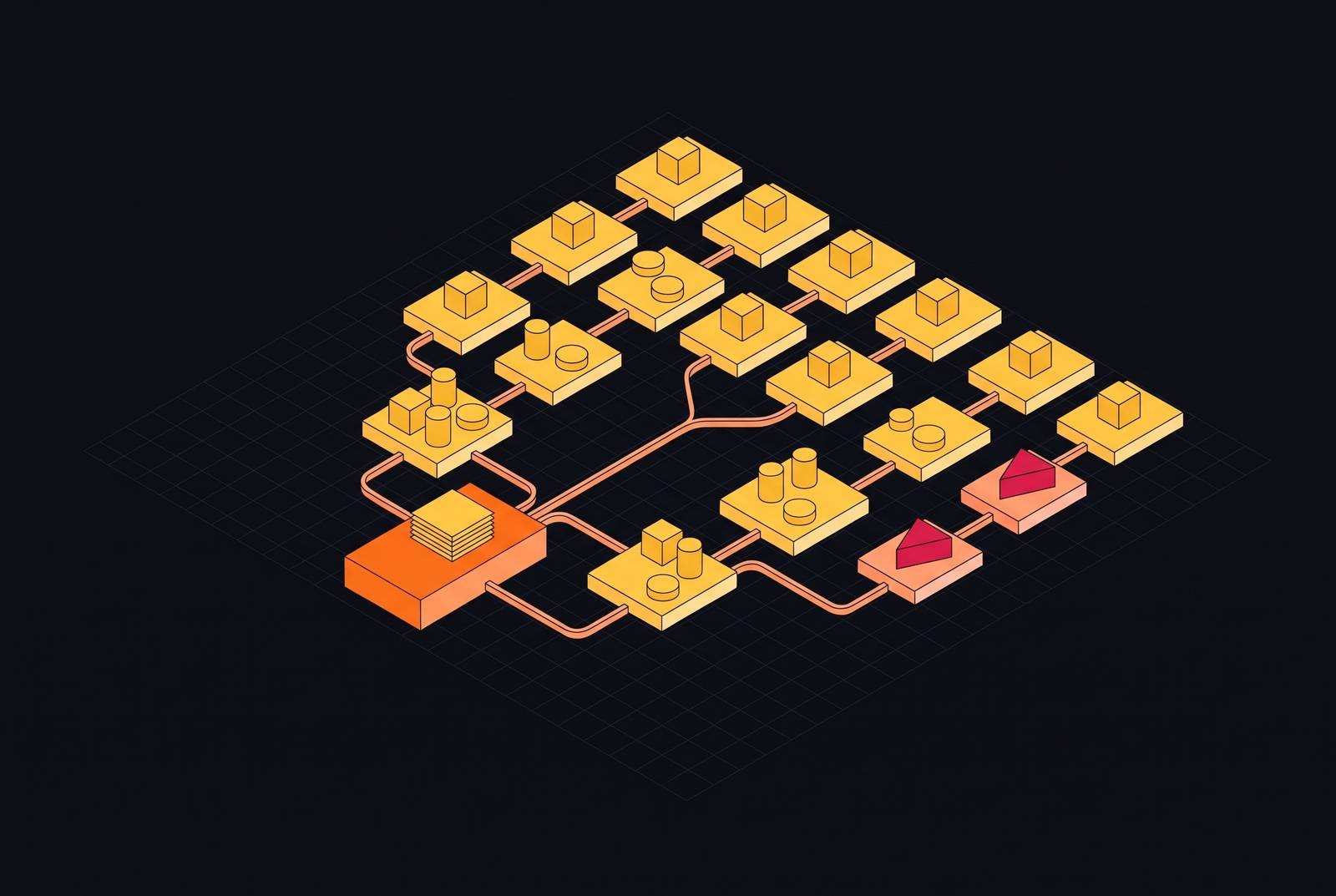
The branch matrix assigns canonical seeds to rows and available agent actions to columns. Each cell runs one action in an isolated copy of the row’s captured state. Isolation makes the comparison meaningful. A terminal state can then become a snapshot for a deeper row, so tests can cover the decisions that follow. Where the implementation distinguishes restore from live fork, the frozen baseline supplies reproducibility and the fork supplies independent continuations.
For Stripe, Seed A contains a customer with an active subscription and no failed payments, with renew, upgrade, and cancel branches. Seed B contains one failed payment and a subscription in its grace period, with branches for a successful retry, a failed retry that triggers dunning, and a customer dispute. Seed C contains a disputed charge under review, with outcomes favoring the customer, favoring the merchant, or issuing a chargeback. These are distinct branch origins. Each continuation must start with only the history of its own seed.
Trajectory assertions provide the first check on each cell by testing tool order and prohibited actions. A refund agent should call lookup_order before issue_refund and never call delete_customer. State assertions then examine what actually changed. Agent-Diff, in 2026, snapshots typed relational tables before and after execution to identify additions, deletions, and modifications that call traces miss. Archal’s multi-environment sandbox design extends the pattern to seeds containing combined GitHub, Slack, and Stripe state.
Three-tier CI architecture that operationalizes the branch matrix
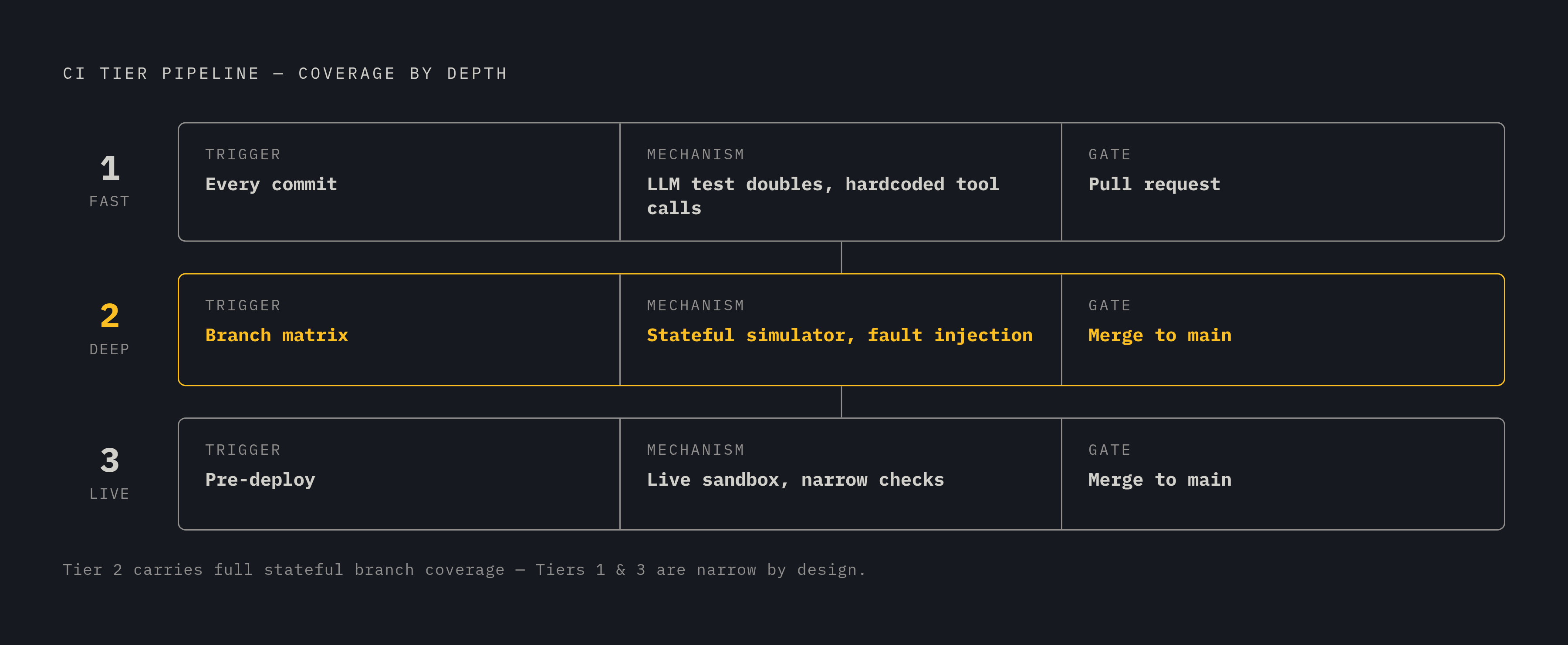
The operational recommendation is to separate cheap orchestration checks, stateful branch tests, and narrow live evaluations. Tier 1 runs on every commit and gates pull requests. It uses LLM test doubles that parse prompts for triggers and return hardcoded tool calls while allowing the real middleware to execute. No live calls are needed. Trajectory assertions here catch tool-use regressions introduced by prompt changes without pretending to prove stateful correctness.
Tier 2 runs the branch matrix in a stateful simulator, with no live credentials and no side effects in production. Canonical seeds are captured once and used in isolated branch tests, including tests that inject latency, 429, and 503. This tier gates merges to main. It runs on feature-branch pushes or a schedule, while Tier 3 uses live sandbox or production evaluations to gate merges to the main branch. Those narrow live checks test whether behavior that passes in the simulator also works against the real API.
Snapshot support reduces deployment work, but its scope needs attention. The same issue reports that deployment fell to 46 seconds with the provider’s snapshot option. Service startup still consumed much of the remainder. That option removed image-pull and deployment steps while leaving the service health-check wait in place, so a saved deployment image preserves only part of the running state. The pipeline’s latency depends on which state its snapshot actually preserves.
Fault injection as a first-class dimension of branch coverage
When a branch succeeds under normal conditions, its recovery behavior is still untested. Each seed-and-action pair also needs runs with faults at specific calls in the chain. The starting state must stay the same from one trial to the next. Reusing its snapshot makes this practical without repeating setup, turning the matrix into seed × branch × fault. Latency, simulated 429s and 503s, and corrupted values exercise behavior that tool-order assertions alone cannot establish.
AgentChaos, described in August 2026 and accepted at ASE 2026, injects crash, omission, and value faults at the LLM API layer [0]. Its most damaging faults returned normal HTTP 200 responses with corrupted or schema-mismatched content. Transport success did not imply usable content. The study reports that Pass@1 fell by up to 49.66 points across five agent systems and four backbone models. It also found stronger recovery in simpler ReAct architectures than in Reflexion architectures, where self-reflection amplified fault impact, making recovery design itself a branch-testing concern.
Fidelity verification as the guarantee that the branch matrix tests what production will do
Coverage against a drifted simulator is false confidence, regardless of how many isolated tests pass. Agent-Diff validates replicas through automated conformance testing against production APIs and adversarial edge-case probing. Its state-diff method checks mutations as well as outputs. This reuses snapshot comparison for a second purpose, namely establishing whether the environment follows the real service’s transitions.
ClawsBench checks mock responses against golden request-response pairs at every step in the trajectory. That process identified 11 recurring bug classes and documented 65 API-specific quirks across five services. Quirks require explicit checks. EnvSimBench addresses circular validation by evaluating the simulator against programmatically verified ground truth. The operational requirement is automated conformance before every simulator release, because a one-time review cannot protect later tests from API drift.
Applying the full workflow to the APIs agents most commonly call in production
For GitHub, useful seeds include an open PR with failing CI, a PR with passing CI and pending review, and a merged PR whose dependent branch has diverged. The review decision branches into approval, requested changes, or a comment. Slack presents a different decision surface. Unread mentions, a direct-message conversation in progress, and a pending workflow confirmation expose choices between sending a DM, posting to a channel, and suppressing a notification. Each choice changes a different set of parts of the workspace state.
For Stripe, the earlier subscription, dunning, and dispute seeds need webhook handling as well as direct-call assertions. Resource mutations must trigger events to exercise integration code in webhook handlers. FetchSandbox treats that behavior as a first-class concern. WireMock’s Stripe template instead supplies stateless stubs for payments, billing, Connect, and Issuing, useful at Tier 1 for pagination, rate-limit envelopes, and auth-refresh logic. Those checks help alongside state-transition tests, which are still needed.
Kalshi seeds can place resting orders on both sides of an open market or a position at risk near resolution. Place, modify, and cancel branches then test sequencing around the agent’s decision. Order-state transitions make sequencing especially consequential here. PayPal seeds can contain an order created but not captured, a captured payment under dispute, or a partially processed payout batch. WireMock’s PayPal template supports stateless branch sketching before those cases move into a stateful simulator.
Resend seeds can distinguish queued email, delivered email with an open event, and bounced email with suppression applied. FetchSandbox covers Resend in its stateful sandbox, while WireMock provides a Resend template. Delivery status supplies the branch origin. Lob seeds similarly distinguish a letter created but not sent, a letter in transit, and a delivered letter with a tracking event. Cancellation tests must separate the states before and after the time-bounded cutoff, rather than treating cancellation as one context-free response.
Snapshot-and-fork as infrastructure for RL agent training, not just testing
RL training needs the same deterministic, warm starting states as integration testing, but applies pressure in two directions. DeltaBox identifies horizontal scaling across parallel rollouts and vertical scaling through each rollout’s search tree. Both depend on inexpensive state reuse. Docker-layer approaches incur container-start and image-pull latency, while microVM approaches incur restore latency. The paper reports checkpoint completion in 14 milliseconds, illustrating why repeated checkpoint and rollback operations become an infrastructure concern at training scale.
AgenticAI-Supervisor, in July 2026, describes a “Run-to-Verify” simulation environment that provides execution traces and verifiable reward signals. That requirement connects training quality directly to simulator fidelity. A reproducible error is still an error. Snapshots supply identical starting conditions, forks isolate exploration, and stateful simulation removes live credentials and rate-limit exposure from the workload. Investment in these primitives therefore serves both branch coverage in CI and controlled exploration during training.
Sources
- DeltaBox: Scaling Stateful AI Agents with Millisecond-Level Sandbox Checkpoint/Rollback
- Simulate to Generalize: Scaling Stateful Supervision for API-calling Agents using LLM World Models
- StateFork: Give Agents a Rewind Button
- ClawsBench: Evaluating Capability and Safety of LLM Productivity Agents in Simulated Workspaces
- Agent-Diff: Benchmarking LLM Agents on Enterprise API Tasks via Code Execution with State-Diff-Based Evaluation