Unintended Cross-Workspace Effects of Slack Enterprise Grid Agents
Org-level tokens and inherited permissions let Slack agents reach far past their workspace.
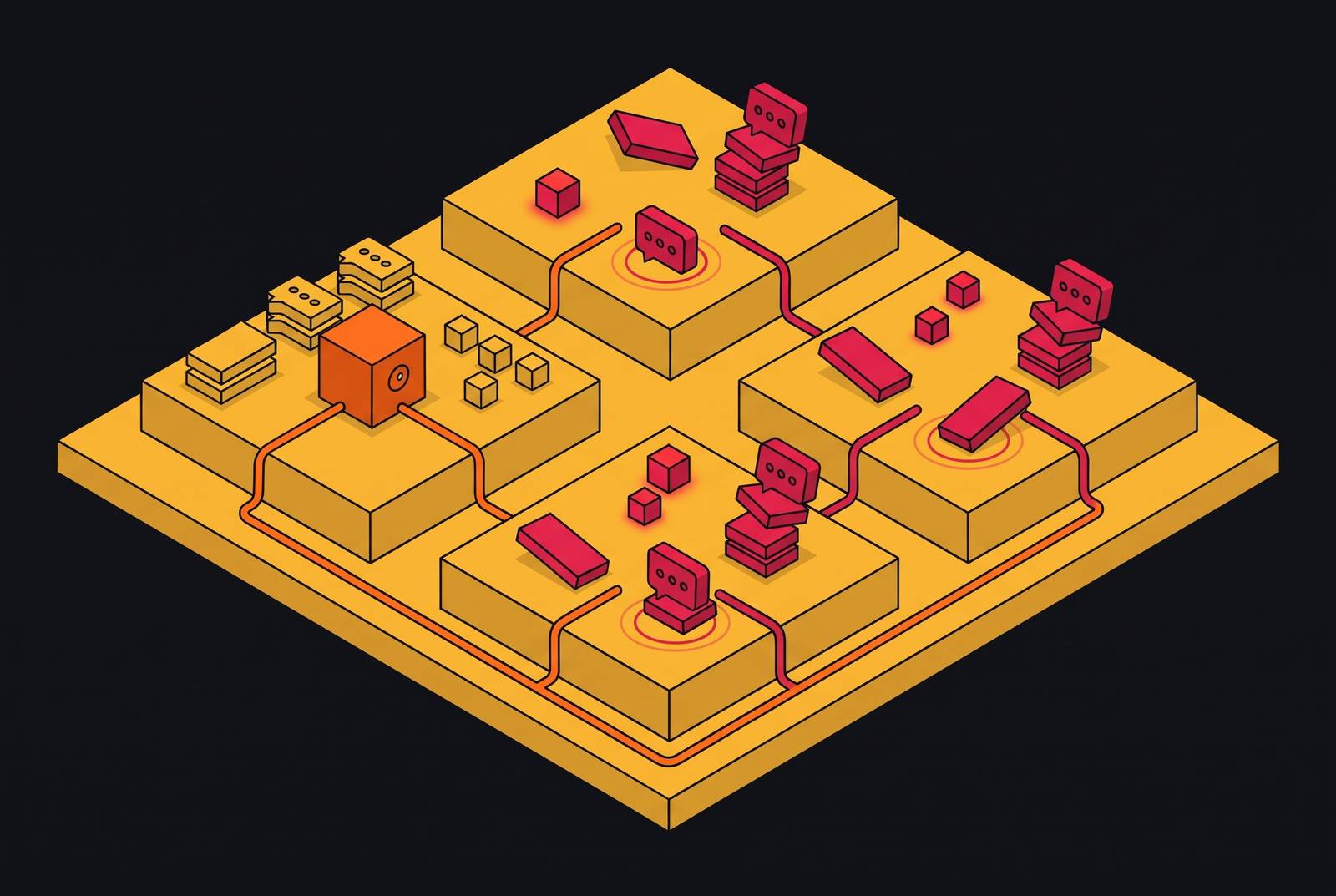
Slack Enterprise Grid agents can have effects far beyond the workspace where administrators expect them to operate. Org-level tokens, unified identity, and accumulated permissions make the workspace an unreliable proxy for an agent’s reach. Containment therefore requires more than limiting where an agent appears. It requires testing what the agent can read and change against a stateful model of the Grid organization.
How Slack Enterprise Grid's architecture makes the workspace boundary disappear
Enterprise Grid changes Slack from isolated workspaces into a federated organization of workspaces. Users receive a single global ID across the organization, although per-workspace local IDs and workspace-level directories still exist. A workspace therefore remains a useful way to organize people and work, but it no longer contains the whole identity model. The same person can be represented across workspace boundaries without becoming a separate organizational identity in each one.
Channels and policies follow a similar shift. Salesforce Trailhead describes multi-workspace channels that span several workspaces within an organization. Org-level policies can override individual workspace settings, so the workspace is no longer the highest control boundary. Apps using admin, Discovery, or SCIM APIs can access the organizational data they need once installed at the org level. These features help people work together and admins manage a large enterprise, but separate workspaces can still share identities, channels, and authority.
What the org-level token model actually grants an agent approved in one workspace
An agent approved at the organization level inherits org-scoped permissions rather than a purely workspace-scoped authorization model. Administrative setup separates that approval from deployment. A Slack admin approves and configures the agent at the Enterprise Grid organization level, then adds the app to one or more workspaces. Those workspaces describe where the app is deployed, but they do not by themselves describe the full scope represented by its credentials.
The token makes that distinction operationally important. Enterprise Grid apps generate an org-level bot token that can represent installations across many workspaces in the organization. Some API methods require a team_id parameter to identify the workspace on which a call should act. Omitting it can produce inconsistent cross-workspace behavior, including unexpected success on shared channels across workspaces where the app is not deployed. Calls to single-workspace channels can instead fail with a team_access_not_granted error.
A successful call is therefore not proof of correct workspace isolation. Its result may depend on the channel’s structure as well as the requested operation and workspace context. Separately, user group management permissions can permit changes to org-wide membership. That mutation path needs to be assessed independently. An agent’s data access and its ability to change organizational membership are distinct parts of its blast radius.
Why permission debt in enterprise workspaces turns a narrow token into a wide one
Formal authorization is only part of the exposure. For an agent acting on a user’s behalf, effective reach also depends on the access that user has accumulated over time. Employees join project channels and stay in them after the projects end. Contractors enter sensitive channels for short engagements without later being removed from those channels. Each decision may have served a legitimate purpose when it was made, while leaving access that outlasts that purpose.
All-hands and other broadly accessible channels can contain compensation discussions, M&A signals, and legal communications that were not intended to be aggregated by a system acting on a user’s behalf. A long-tenured user may also retain nominal access to private channels covering subjects far beyond their current role. Those channels expand the material an authorized agent can retrieve and recombine. Access history becomes a data surface in its own right.
The user’s accumulated access follows the global identity rather than ending at the workspace where an agent was introduced. For an agent operating on that user’s behalf with an org-level token, the interaction between token scope and permission history determines the practical exposure. This does not mean every org-level bot token automatically inherits every user permission. A permissions page alone cannot show how far a user-authorized agent can reach when the user’s access has grown over years.
How a misconfigured "explicit grant" gate lets cross-workspace access happen silently
The org-level OAuth installation flow includes an explicit grant step intended to constrain which workspaces an agent can reach. That grant is a critical setup gate. If it is misconfigured, the administrator’s intended boundary and the agent’s effective reach can diverge without preventing the agent from working.
Workspace selection in API calls creates another point of divergence. Where a method requires team_id, omitting that context can expose the shared-channel behavior described earlier. User group management gives an agent a third, separate path. If that permission remains open rather than blocked, an agent can mutate org-wide group membership rather than only membership within the installing workspace. Constraining channel access does not establish that this write path is constrained too.
The agent can answer queries or complete tasks while operating across a wider surface than the administrator intended. That cross-workspace reach is not visible in normal audit flows. As a result, successful use is a weak test of a correct grant. The relevant distinction is between an operation that works and an operation that works only within its intended boundary.
Slack Connect as the outer boundary of the blast radius
Slack Connect extends the consequence beyond internal workspace governance. When an agent posts information into a channel containing external participants, the destination crosses the organization boundary. That does not mean a multi-workspace channel is also a Slack Connect channel. The two channel types are mutually exclusive. The risk instead comes from an agent treating a Connect destination as internal while writing summaries, posting cluster data, or responding to queries.
The missing signal is the audience outside the organization. An agent operating in such a channel has no native mechanism in its context for detecting that external participants are present. Without that distinction, a channel’s apparent role in an internal workflow does not establish who can receive its output. Large organizations may have several workspaces after buying other companies or because they have divisions in different regions. Cluster data, deal information, or internal metrics posted into a channel the agent treats as internal may consequently reach an external counterparty.
Slack Connect is widely used in the enterprise organizations likely to run Grid. This makes the destination boundary something to check in day-to-day use, even when the setup is common. Even when an agent is allowed to retrieve information, that authorization does not establish that every channel where it can respond has an appropriate audience.
The channel-restriction control that partially addresses this, and what it does not cover
Channel-level access restrictions provide a useful deployment control on Enterprise+ and Enterprise Grid. Organizations on lower tiers do not have that control. For eligible organizations, restrictions limit the channels available to an agent, reducing the surface on which it can operate. That is a concrete containment measure.
An agent restricted to three channels still holds an org-level token. The restriction also leaves accumulated permission debt within allowed channels unresolved, including information whose original audience was never expected to include an aggregating agent. Separately, it does not prevent org-wide user group mutation through the agent’s handle-management mechanism. Channel restrictions address where an agent operates without fully defining what its credentials and other permissions can do.
Trailhead treats new workspace creation as a last resort, favoring multi-workspace and org-wide channels where they meet the organization’s needs. Following that discipline can produce a simpler graph for an agent to traverse, but a wider one. Fewer workspace divisions do not necessarily mean narrower channel reach. Containment therefore depends on understanding the resulting graph rather than treating the number of workspaces as a measure of isolation.
Why you cannot test agent blast radius against live Grid workspaces
Establishing those boundaries requires tests that can expose unintended reach without exercising it against production. Live Grid makes that difficult and risky. A user group mutation changes real org-wide membership, while a channel-read test can show that the agent has access to channels the tester never meant to include. An org-level token also allows test actions to propagate across workspaces without an easy rollback. A test of the boundary can itself become the cross-boundary event.
Production constraints further limit repeatable testing. Slack API rate limits apply per API method, per workspace, per app, so aggressive agent testing can degrade production API access. Migration adds another source of risk when authorization and workspace arrangements are changing at the same time. The classic app retirement deadline was originally November 16, 2026, but was paused as of December 2025. Organizations actively migrating still face the practical problem of testing agent reach while the environment being tested is in transition.
The required tests are specific to Grid’s structure. They must establish that an agent scoped to workspace A cannot read channels from workspace B, and that user group writes remain within the expected scope. They must also exercise different handling for Slack Connect channels and internal channels, together with token refresh and re-authentication across workspace boundaries. These are not independent response checks. Each can depend on identities, permissions, and changes established by earlier calls.
A controlled replica must therefore remember the world between requests. An add-then-list-then-remove sequence needs to expose the correct state at each step, including effects visible from another workspace. A stateless mock cannot show how those steps are linked just by returning responses that each look right on their own. Tests must establish whether the sequence of successful operations leaves only the intended organizational state.
What a stateful Slack simulator makes testable that mocks and sandboxes cannot
A stateful Slack simulator makes cross-workspace consequences observable without changing a live organization. It remembers an action taken in workspace A when the agent later queries workspace B. User group mutations are visible in later list calls, so a test can check whether the agent wrote to an org-wide group. Channel membership and external participant presence can also be seeded before a run. The agent then meets an audience boundary that is known before the test, without having to disclose information in production to discover it.
Deterministic faults extend that test beyond the successful path. A simulator can inject 429s, delayed responses, and partial workspace data to exercise the agent’s handling of Grid-specific error conditions. Recorded cassettes cannot substitute for this evolving state because they replay a fixed response sequence. A replay can reproduce what a prior call returned without calculating how a new action changes what another workspace exposes. That distinction is decisive when the defect lies in the relationship between calls.
Sandbox capabilities also need a precise distinction. A sandbox workspace is not a Grid organization and cannot by itself reproduce the org-level token model. Access to a Grid environment and a deterministic simulation that can be reset locally meet different testing needs. The simulator makes known cross-workspace states and faults repeatable without depending on Grid infrastructure availability.
For CI, the practical step is to run a full cross-workspace scenario whenever a pull request changes agent channel-access logic or user group management. A locally hosted simulator can make that scenario deterministic and independent of a live Grid organization. For RL environments using Slack as a tool surface, resettable state also lets cross-workspace trajectories become training fixtures that can be replayed without side effects. The same requirement underpins both uses. When production is not a safe place to test the blast radius, the test environment must hold Grid-level state.